
S. N. Ahsan

Syed Nazmul Ahsan

Mechanical Engineer

Focus Focus areas: heat transfer and thermal energy storage, CFD with phase-change modelling, HVAC and chilled-water systems, supercritical CO2 power cycles, carbon capture and life-cycle assessment.

B.Sc. in Mechanical Engineering from the Islamic University of Technology (IUT), Bangladesh. My work is in heat transfer, CFD and energy systems.

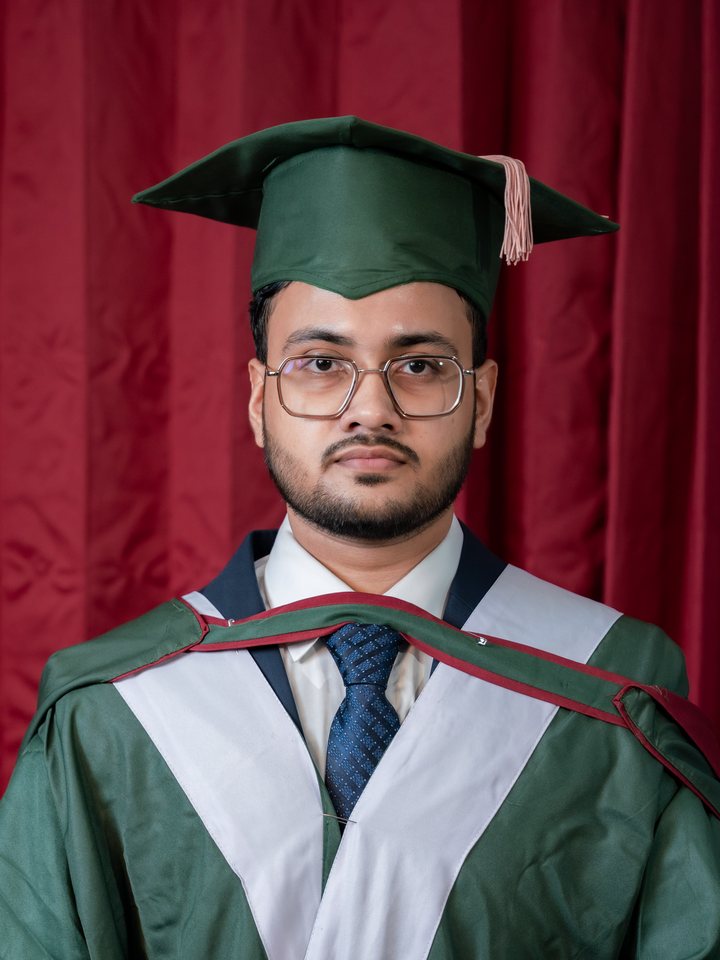
Portrait of Syed Nazmul Ahsan
Fig. 1 Planetary gear train drawn with true involute teeth. It turns at its real ratio as you scroll. Sun 60Planets 6 × 18Ring 96, fixedRatio 2.6 : 1
CGPA
3.86/4.00
First Class with Honours
Thesis
10CFD cases
Transient PV-PCM simulations in ANSYS Fluent
Industry
4weeks
HVAC project at Unilever Bangladesh
Leadership
6member team
Capstone team leader, MAGLEV wind turbine

About

I graduated from the Islamic University of Technology (IUT) in October 2026 with a B.Sc. in Mechanical Engineering, First Class with Honours and a CGPA of 3.86 out of 4.00.

Most of my work so far is in heat transfer and energy systems. For my thesis I modelled the cooling of a solar panel with a phase change material and aluminium fins in ANSYS Fluent. I also co-developed a Python model that tests the carbon capture assumptions in Bangladesh's energy master plan. In my own code I reproduced published supercritical CO2 power cycle results.

Outside the university I spent four weeks at Unilever Bangladesh's Kalurghat factory on a project about its chilled-water HVAC system. I also led a six-member capstone team that designed, built and tested a magnetically levitated wind turbine.

Open to engineering roles and graduate research opportunities.

Research interests

  • Heat transfer
  • Thermal energy storage
  • CFD
  • Supercritical CO2 power cycles
  • Carbon capture

Education

  1. Graduated October 2026

    B.Sc. in Mechanical Engineering

    Islamic University of Technology (IUT), Gazipur

    • CGPA 3.86/4.00, First Class with Honours
    • 3.96 and 3.94 in the final two semesters
    Fig. 2 GPA in each of the eight semesters, from the IUT grade sheet. The dashed line is the final CGPA.
    Syed Nazmul Ahsan in the IUT graduation gown and cap
    Graduation, October 2026

    Selected A+ coursework

    • Principles of Heat and Mass Transfer
    • Applied Heat Transfer
    • Fluid Mechanics II
    • Fluid Machinery
    • Power Plant Engineering
    • Refrigeration and Air-Conditioning
    • Computational Mechanics
    • Numerical Analysis
    • Industrial Management
    • Probability and Statistics

    Certificate Transcript

  2. 2021

    Higher Secondary Certificate (HSC), Science

    Notre Dame College, Dhaka | Board of Intermediate and Secondary Education, Dhaka

    • GPA 5.00/5.00

    Certificate Transcript

  3. 2019

    Secondary School Certificate (SSC), Science

    Ideal School and College, Motijheel, Dhaka | Board of Intermediate and Secondary Education, Dhaka

    • GPA 5.00/5.00

    Certificate Transcript

Research

Undergraduate thesis | 2026 | Group of four

Thermal Analysis of a Solar Panel with a PCM-Filled Cavity and Modified Fin Arrangement with a Proposed Pipe-Integrated Configuration

In short: how the arrangement of aluminium fins in a cavity of phase change material changes the cooling of a solar panel, studied with CFD.

Department of Mechanical and Production Engineering (MPE), IUT | Supervisors: Prof. Dr. Md. Rezwanul Karim and Prof. Dr. Arafat Ahmed Bhuiyan

Faster melting with fins
17.4 to 30.3%
Cooler PV wall, best case
9.3K
Gap to published values
3.4 to 5.1%
Method and results
  • Modelled an RT25 phase change material (PCM) cavity with five aluminium fins behind a photovoltaic (PV) panel as a 2D transient conjugate heat transfer problem in ANSYS Fluent (enthalpy-porosity method). Drew the 132 mm by 20 mm geometry in DesignModeler and meshed it with about 48,000 quadrilateral cells.
  • Ran ten cases with the mathematical model and operating conditions of Jamal et al. (2026): three fin arrangements at average fin lengths of 6, 9 and 12 mm plus an unfinned cavity. Complete melting times were within 3.4% to 5.1% of their published values.
  • Processed the results in Python (NumPy, SciPy, pandas, Matplotlib). Fins shortened complete melting by 17.4% to 30.3% but the fastest-melting arrangement was not the coolest. Inclined edge-biased fins at 12 mm lowered the PV-side wall temperature by 9.3 K against a median of 5.0 K for the nine finned cases.
  • Concluded that wall temperature is a better criterion than melting time for choosing a fin arrangement, since PV efficiency depends on cell temperature.
  • Designed and meshed a follow-up cavity with four coolant channels in the PCM (about 72,000 cells) for future work. Co-wrote the thesis report and presented at the defence.
  • ANSYS Fluent
  • ANSYS DesignModeler
  • Python
  • NumPy
  • SciPy
  • pandas
  • Matplotlib

The ten cases, to scale

Average fin length

Coolest PV-side wall of the ten cases: 9.3 K below the unfinned cavity, against a median of 5.0 K for the nine finned cases.

  • Aluminium plates and fins
  • RT25 phase change material
  • Coolant channel (follow-up design only)
Fig. 3 Section through the cavity, dimensions in mm. Rotated 90° to fit the page: in the model the heated plate is vertical and gravity acts along the 132 mm side. The channels in the follow-up design are placed schematically.

Research project | 2026 | With M. Hassan and S. K. Ahsan

Gas-Fired Power with CO2 Capture in Bangladesh: Techno-Economic and Life-Cycle Assessment

In short: a test of the carbon capture and storage (CCS) assumptions in Bangladesh's Integrated Energy and Power Master Plan (IEPMP 2023).

Method and results
  • Tested the plan's CCS assumptions with a linked model of rate-based MEA post-combustion capture, CO2 compression and pipeline transport, plant costing and a life-cycle inventory of domestic gas and imported LNG.
  • Co-developed the Python model, compiled input data from the plan and published sources, produced the results and figures and co-wrote the report. Uncertainty was assessed with Monte Carlo and Sobol analyses.
  • Main findings: the plan's CCS cost matches the model only when the energy penalty of capture is left out. Its fuel budget implies a net efficiency with capture above the record for plants without capture.
  • Counted over the full life cycle, the planned 2050 gas-CCS fleet would emit several times the plan's CO2-equivalent figure.
  • Python
  • Techno-economic modelling
  • Life-cycle assessment
  • Monte Carlo
  • Sobol analysis

The linked model

  1. Fuel supplydomestic gas, imported LNG
  2. Gas-fired plant
  3. MEA capturerate-based
  4. CO2 compression
  5. Pipeline transport

Plant costing | Life-cycle inventory | Monte Carlo and Sobol analyses

Three checks against the master plan

  1. Cost of adding CCS The plan's figure matches the model only when the energy penalty of capture is left out.
  2. Net efficiency with capture The plan's fuel budget implies an efficiency above the record for plants without capture.
  3. Emissions of the 2050 gas-CCS fleet Several times the plan's figure when the full life cycle is counted.

Independent research project | 2026

Computational Reproduction of Combined S-CO2/ORC Power Cycles for Solar Power Tower Plants

In short: rebuilding the results of a published paper in my own Python code and checking them against the paper.

Cycle layouts reproduced
4
Property calls, first version
115million
Method and results
  • Reproduced the thermodynamic and techno-economic results of Fan et al. (2024, Applied Thermal Engineering) for four supercritical CO2 (S-CO2)/organic Rankine cycle (ORC) layouts: recuperated, recompression, intercooling and partial cooling. Checked efficiency and cost against curves digitised from the paper.
  • Wrote the code in Python on CoolProp's low-level AbstractState interface, with equipment cost correlations and CEPCI cost escalation. The first version needed about 115 million property calls. Vectorisation and cached interpolation brought the run time down.
  • Python
  • CoolProp
  • Thermodynamic modelling
  • Techno-economic analysis

S-CO2 cycle with an ORC bottoming loop

  1. Compressor
  2. Recuperator
  3. Heater (solar tower)
  4. Turbine
  5. ORC evaporator
  6. Cooler
  7. ORC turbine
  8. Condenser
  9. Pump
  • Cold
  • Warm
  • Hot
Fig. 4 Illustrative layout of the recuperated cycle, drawn for this page. It is not a figure from the paper. The line colour shows where the working fluid is cold, warm or hot.

Experience

Sep 2025 to Oct 2025 | 4 weeks | Kalurghat, Chattogram

Project-Based Industrial Internship, Unilever Bangladesh Ltd.

Project: HVAC Chilled-Water System Analysis

  • Studied energy losses in the factory's chilled-water HVAC system as part of a project team. Located the main pressure drops across the evaporator and distribution lines with pipe head-loss analysis.
  • Estimated the total system pressure drop at about 3.3 bar (about 33 m of head) and evaluated the chiller pump. Major changes to the pump system were not needed under the conditions studied.
  • Identified two options for reducing losses: lower flow rate through smart pump control and better evaporator performance. Presented the findings and received a Certificate of Excellence for Project Based Work.
  • HVAC
  • Chilled-water systems
  • Pipe head-loss analysis
  • Pump evaluation

Certificate

Total system pressure drop

Pressure drop
about 3.3bar
As pump head
about 33m

Projects

Capstone Design II | Mar 2026 | Team Leader (six members)

MAGLEV-Based Vertical Axis Wind Turbine for Efficient Energy Generation

Supervisor: Dr. Mohammad Nasim

  • Led a six-member team that designed, built and tested a small vertical axis wind turbine. NdFeB permanent magnets partly levitate the rotor to reduce bearing friction and a multi-coil generator sits at the base.
  • Divided the work among the team and tracked the BDT 15,000 budget. Handled the test-data analysis, report writing and presentation.
  • In airflow tests against a bearing-supported turbine of similar size, the prototype started more easily and gave higher open-circuit voltage at low wind speeds.
  • Team leadership
  • Prototype fabrication
  • Testing
  • Budget tracking

Poster Certificate

The prototype on test

Silent test video and photos of the team's prototype. Select a photo to enlarge it.

Course project | 2026

Energy, Exergy and Parametric Analysis of Eight S-CO2 Power Cycle Configurations

Complex Engineering Problem, Power Plant Engineering (ME 4805)

  • Compared eight S-CO2 cycles through energy, exergy and parametric analysis: four bottoming cycles for a 5 MWe landfill-gas turbine (Kim et al., 2016) and four solar power tower layouts (Fan et al., 2024).
  • Checked the bottoming-cycle models against published values (mean absolute deviation of 2.63% over 28 comparisons) and added automatic checks for exergy closure and heat-exchanger temperature crosses.
  • Python
  • CoolProp
  • Exergy analysis

Course project | Six-member group

Cooling Load Estimation for a Commercial Space

Refrigeration and Air-Conditioning (ME 4713)

  • Estimated the design cooling load of a 40 m² room at a retail outlet in Board Bazar, Gazipur by the CLTD/CLF method in an Excel workbook.
  • Calculated wall, roof and floor U-values from material layers, then added the four groups of heat gain. Total: about 6.5 kW.
  1. Conduction through walls, roof and floor
  2. Solar gain through glazing
  3. Ventilation, sensible and latent
  4. Occupants, equipment and lighting
  • CLTD/CLF method
  • Microsoft Excel

Control-system project | Dec 2024

1D Ball Balancing Robot

Cezeri Lab Annual Project Showcase Competition 2024, IUT

  • Developed a one-dimensional ball balancing robot and presented it at the Cezeri Lab Annual Project Showcase Competition 2024 at IUT. Received a Recognition of Achievement.
  • Control systems

Certificate

The line drawings on this page are schematics drawn for the site. They show the idea of each project and are not results.

Skills

Simulation and CAD

  • ANSYS Fluent
  • ANSYS DesignModeler
  • SolidWorks

Programming

  • Python
  • MATLAB
  • C

Python libraries

  • NumPy
  • SciPy
  • pandas
  • Matplotlib
  • CoolProp

Methods

  • Computational fluid dynamics (CFD) with phase-change modelling
  • Conjugate heat transfer
  • Energy and exergy analysis
  • Techno-economic modelling
  • Life-cycle assessment
  • Monte Carlo and Sobol sensitivity analysis
  • Cooling-load estimation (CLTD/CLF)
  • Pipe head-loss analysis

Office and data

  • Microsoft Excel
  • Power BI
  • Word
  • PowerPoint

AI tools

  • ChatGPT
  • Claude

Used for coding support and data analysis

Awards and Certificates

  • Mar 2026

    Recognition of Achievement, Capstone Design Project

    Department of MPE, IUT

    Certificate
  • Oct 2025

    Certificate of Excellence for Project Based Work

    Unilever Bangladesh Ltd.

    Certificate
  • Dec 2024

    Recognition of Achievement, Cezeri Lab Annual Project Showcase Competition 2024 (1D Ball Balancing Robot)

    Department of MPE, IUT

    Certificate
  • 2024

    Champion, Badminton (Doubles)

    IUT Annual Badminton Competition

    Certificate

References

Research collaborator

Mahadehe Hassan

Deputy Director (Planning & PSC), Hydrocarbon Unit

Energy and Mineral Resources Division, Ministry of Power, Energy and Mineral Resources, Bangladesh

mahadehe@hcu.org.bd

Contact

Email or phone is the quickest way to reach me.

Address
240/I, Zaker Road, East Rampura, Dhaka-1219, Bangladesh

Curriculum vitae

Write a message

This opens your email app with the message ready to send. Nothing is stored on this site.